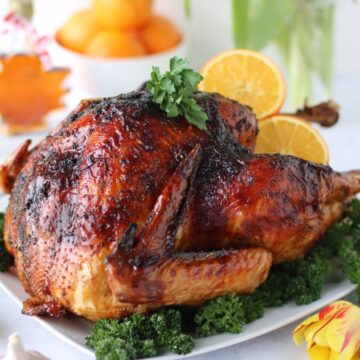
Maple Orange Turkey Roast
Glaze a whole turkey with a mixture of butter, maple syrup, herbs and orange zest for amazing flavors.
Equipment
- Roasting Pan with Rack
Ingredients
- 1 Whole Turkey see notes
- ½ cup Unsalted Butter at room temperature
- ¼ cup Maple Syrup
- 1 tablespoon Herbes de Provence
- ½ teaspoon Smoked Paprika
- 1 teaspoon Salt omit if using salted butter
- 2 cloves Garlic minced
- 2 teaspoon Orange Zest from 1 orange
- 2 cups Chicken Broth or Turkey if you can find it
Instructions
- Start by following the instructions on the package or in the Notes below, for best practices on how to thaw a whole turkey. If preparing a pre-stuffed turkey, please follow any instructions included in its packaging, since the thawing and baking time will be different.1 Whole Turkey
Preparing the Thawed Turkey
- Preheat the oven to 400F, so the turkey gets a nice blast of initial heat.
- Remove carefully, the thawed turkey from its packaging. Untie the legs discard any plastic or ties, holding it closed.
- Remove the neck, giblets, and any else from the turkey cavity. Remove the turkey from its thawing juices, letting most of them drip off and transfer to a clean platter.
- Gently lift the turkey skin without tearing it. Start at the cavity end and slowly work your fingers between the skin and the meat, loosening it over the breast and down toward the thighs.
- Choose large roasting pan with built in rack to allow heat to circulate evenly and keep the bird elevated from its juices. Transfer the turkey to the roasting pan and let it rest.
Glazing the Turkey
- Prepare the maple butter by whisking together the room temperature butter and the maple syrup. Continue by adding in the herbs, orange zest, paprika, and minced garlic. Mix until smooth.½ cup Unsalted Butter , ¼ cup Maple Syrup , 1 tbsp Herbes de Provence , ½ tsp Smoked Paprika , 1 tsp Salt, 2 cloves Garlic , 2 tsp Orange Zest
- Use your hand to smother some of the maple butter inside of the loosened skin so that the flavor gets right to the meat. Brush all over the outside of the turkey, making sure to still have ⅓ of the glaze reserved at the end. Take the zested orange, cut it in half or quarters and place it in the cavity.
Roasting and Basting the Turkey
- Place the glazed turkey in the preheated oven and right way turn the temperature down to 350F. Roast for any initial 30 minutes. Optionally, cover the turkey loosely with foil for the first hour no prevent it from becoming too dark. Often this is necessary when roasting a larger bird, over 12 pounds.
- Remove the turkey from the oven. Brush the rest of the glaze all over the turkey. Use pieces of aluminum foil to cover the wing tips and legs of the turkey to prevent them from burning. Pour the chicken broth into the roasting pan (not on the turkey) and return the turkey to the oven.2 cups Chicken Broth
- Take the roasted turkey out of the oven ever 45 minutes and baste the turkey by using a basting tool, or spooning dripping from the pan over the bird.
- Take the Turkey Roast out of the oven when the approximated cooking time for the weight of the bird has been reached. (see notes). Use a probe thermometer to make sure that all the parts of the turkey are at the right temperature, making sure not too touch any bones with the probe.
- Make sure to let the roasted turkey rest, for at least 20 minutes before carving into it, to allow the juices to settle back into the meat.
Notes
How to Thaw a Whole Turkey
To thaw a turkey safely in the refrigerator, follow these simple steps:-
- Place the turkey on a tray or in a pan to catch any juices that may leak.
-
- Keep the turkey in its original packaging to prevent contamination.
-
- Allow 24 hours of thawing time for every 4 to 5 pounds (1.8 to 2.3 kg) of turkey.
-
- For example:
-
- 8–12 lbs (3.6–5.4 kg): 2–3 days
-
- 12–16 lbs (5.4–7.3 kg): 3–4 days
-
- 16–20 lbs (7.3–9.1 kg): 4–5 days
-
- 20–24 lbs (9.1–10.9 kg): 5–6 days
-
- For example:
-
- Allow 24 hours of thawing time for every 4 to 5 pounds (1.8 to 2.3 kg) of turkey.
-
- Keep the refrigerator at or below 40°F (4°C) throughout the thawing process.
-
- Cook the turkey within 1–2 days after it’s fully thawed.
Roasting Time for Unstuffed Turkey
Roast a whole turkey at 350°F (175°C), plan for about 13 to 15 minutes per pound if the turkey is unstuffed. Here's a general guideline:-
- 8–12 lbs: 2¾ to 3 hours
-
- 12–14 lbs: 3 to 3¾ hours
-
- 14–18 lbs: 3¾ to 4¼ hours
-
- 18–20 lbs: 4¼ to 4½ hours
-
- 20–24 lbs: 4½ to 5 hours
-
- 170°F (77°C) in the breast
-
- 180°F (82°C) in the thigh
-
- 165°F (74°C) if the turkey is stuffed (measure in the center of the stuffing)
Nutrition
Calories: 393kcalCarbohydrates: 5gProtein: 47gFat: 20gSaturated Fat: 8gPolyunsaturated Fat: 3gMonounsaturated Fat: 6gTrans Fat: 0.4gCholesterol: 176mgSodium: 581mgPotassium: 513mgFiber: 0.2gSugar: 4gVitamin A: 413IUVitamin C: 1mgCalcium: 43mgIron: 2mg
Tried this recipe?Let us know how it was!